
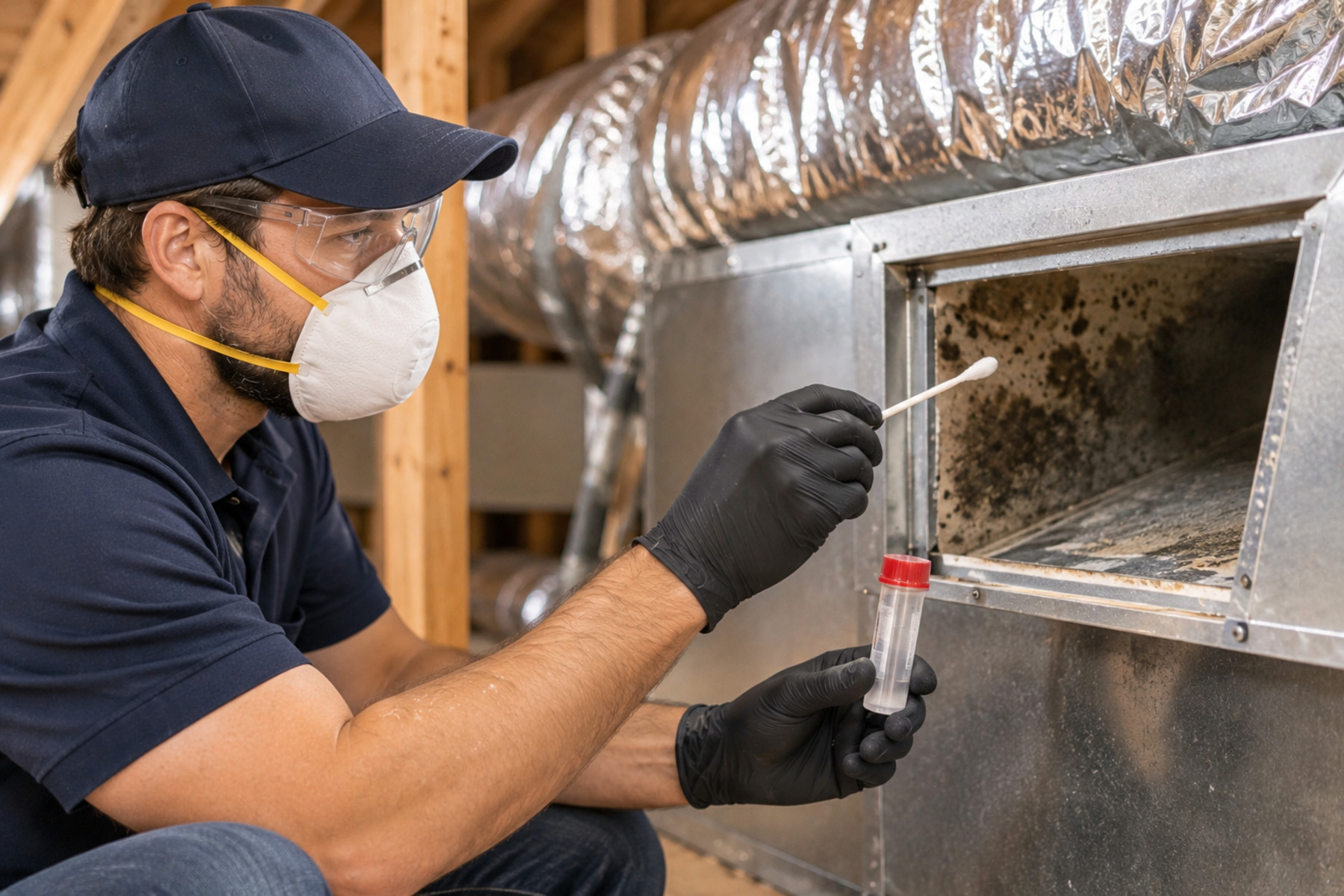
Mold growth inside your HVAC system can cause musty odors and spread fungal spores to connected rooms.
For homeowners and property managers in San Diego and Orange County, understanding when HVAC mold testing is necessary can help identify suspected contamination without paying for unnecessary sampling. A professional assessment can help determine whether further testing or cleanup is needed.
Here is a practical, plain-English guide to HVAC mold testing. You will learn what testing really is, how pros do it, when it helps, and when you should skip it and go straight to fixing moisture and cleaning the system.
If you remember only one thing, make it this: moisture control and a thorough inspection come first. Lab tests are tools, not the goal.
TL;DR
- Testing helps when you need to confirm contamination inside the HVAC, document scope, or verify cleanup, but it’s not routine.
- No federal health-based limits exist for indoor mold, so results are interpreted against outdoor air and building conditions.
- If you see visible mold or smell a persistent musty odor, fix moisture, clean or replace affected HVAC parts, and don’t rely on air sampling alone.
- If you suspect significant mold contamination inside your HVAC system, have it evaluated before continuing to operate the affected equipment. Running a contaminated system may spread spores.
- Choose contractors who follow established HVAC inspection and cleaning standards.
What HVAC Mold Testing Really Means
HVAC mold testing involves more than collecting an air sample. During an assessment, an environmental professional may inspect accessible HVAC components, investigate moisture conditions, and evaluate suspected contamination.
If laboratory testing is needed, the professional selects sampling methods based on your property’s conditions and the questions the assessment needs to answer.
Because the United States has no federal exposure limits for indoor mold, testing is about finding sources and verifying cleaning, not proving a number is safe or unsafe. Public health agencies consistently emphasize fixing water problems and removing moldy materials as the primary response.
Common Testing Methods and What They Show
If you own a home in coastal San Diego communities like La Jolla, Del Mar, or Encinitas, humidity and condensation may contribute to HVAC moisture problems. Understanding the available testing methods can help you determine whether suspected mold needs further investigation.
- Visual inspection and moisture assessment: The cornerstone. Pros use lights, mirrors, borescopes, hygrometers, moisture meters, and sometimes infrared cameras to spot leaks, condensation, or wet insulation. A musty odor is a red flag even if growth is hidden.
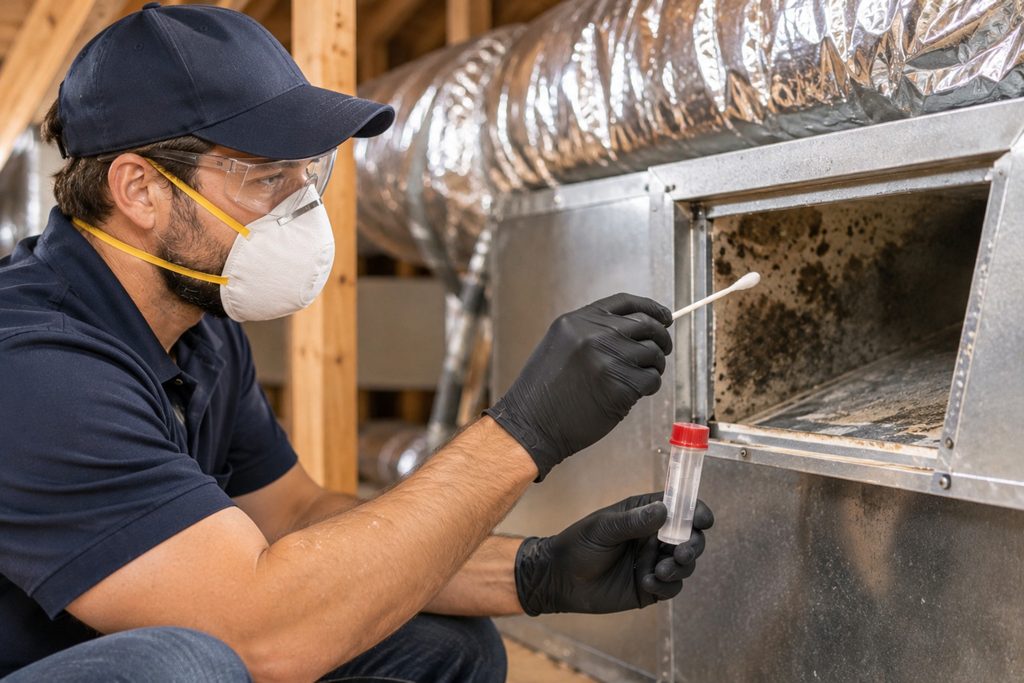
- Surface sampling: Tape lifts or swabs from suspected HVAC surfaces can help identify fungal material. These samples may also support post-remediation verification, but results must be considered alongside visual inspection and moisture conditions.
- Air sampling: Spore-trap or culture samples measure airborne fungal particles at the time of collection. Results may help identify patterns that warrant further investigation, but cannot independently locate hidden mold or establish health risks.
- Bulk sampling: Small pieces of contaminated duct liner or insulation analyzed in a lab; used when deciding whether to discard or restore materials.
- DNA-based screening tools like ERMI: Developed for research on house dust, these tools aren’t validated for public decision-making about cleanup, HVAC performance, or health.
If you’re unsure whether the dark material inside your vents is mold or accumulated dust, Rarefied Air Environmental can evaluate the suspected contamination. Our mold testing services include targeted surface sampling and laboratory analysis to help identify the material before you decide on cleanup.
When You Should Consider HVAC Mold Testing
If your vents smell musty, your HVAC system has experienced water damage, or you notice unexplained moisture, a professional assessment can help identify whether further investigation is needed.
- You have a persistent musty odor from the vents, and you cannot see the source.
- You find water damage inside the air handler, coil cabinet, or ducts; the drain pan has overflowed; or the condensate line is clogged.
- Occupants report symptoms that improve away from the building and the HVAC is a likely pathway.
- You need documentation for a remediation scope, insurance, or clearance after cleaning.
- Large or complex buildings where hidden contamination or multiple air handlers make source-finding difficult.
If mold growth has already been confirmed inside your HVAC system, you may not need additional sampling before remediation. Instead, an environmental professional can help assess the affected areas, while qualified HVAC or remediation contractors address the moisture source and contaminated materials.
If your vents smell musty but you can’t find visible mold, our environmental testing specialists can assess suspected contamination and use targeted sampling when appropriate. For San Diego homeowners and property managers, our mold inspections provide documented findings to help determine the next steps.
Should You Test or Go Straight to Cleanup?
If you aren’t sure whether your HVAC system needs mold testing or immediate cleanup, use the situations below to help determine the next step.
| Situation | Test First? | Why |
| Visible mold on coil housing, blower, or duct liner | Usually no | Cleanup and moisture repair are required regardless of species or count. |
| Strong musty odor from vents, no visible growth | Often yes (targeted) | Surface or limited air sampling can help locate hidden sources and guide scope. |
| Post-remediation verification | Case-by-case | Visual inspection and moisture correction come first. Targeted samples may help document remediation results when appropriate. |
| Legal, insurance, or multi-tenant documentation | Yes (case-by-case) | Creates a defensible record of conditions and corrective actions. |
| Routine screening with no complaints | No | Agencies do not recommend routine mold air sampling; focus on inspection and maintenance. |
How Professionals Test an HVAC System Step By Step
Knowing what happens during an HVAC mold assessment can help you prepare for the inspection and understand the findings.
- Pre-assessment and safety: The environmental professional reviews your concerns, previous water damage, and relevant maintenance history. If significant contamination is suspected, they can recommend precautions to limit potential spore distribution.
- Check older HVAC materials: Before disturbing older insulation or duct materials, an appropriate professional may recommend asbestos testing. This helps identify materials that require specialized handling.
- Inspect accessible components: Qualified professionals examine accessible HVAC components and surrounding materials for moisture, visible growth, and suspected contamination.
- Evaluate moisture conditions: The assessment may include humidity measurements, moisture testing, and inspection of areas with condensation or water damage.
- Select appropriate samples: If testing is warranted, the environmental professional determines whether surface, air, or bulk samples will provide useful information.
- Interpret laboratory results: The environmental consultant evaluates laboratory findings alongside inspection observations and moisture conditions.
- Plan corrective work: Based on the findings, qualified HVAC or remediation contractors determine and perform appropriate cleaning, repairs, or material replacement.
- Verify remediation: After cleanup, an environmental professional can assess the completed work. Targeted sampling may be included when appropriate to document whether remediation objectives have been met.
How Results Are Interpreted Without Federal Limits
EPA and other federal agencies have no health-based standards for mold levels in indoor air. That means a single airborne spore number cannot prove a space is safe.
Instead, professionals look at patterns:
- Whether indoor spore types mirror or exceed outdoor air
- Whether water-damage indicator genera appear indoors
- Whether surfaces are visibly clean
- Whether odors persist
If growth is present, remove it and fix moisture, regardless of mold type.
Remediation and Prevention Tied to Testing
Once mold contamination is identified, your next step is to determine what needs professional remediation and what you can do to prevent future moisture problems. HVAC contractors handle equipment cleaning and repairs, while environmental professionals can assess contamination and, when appropriate, verify completed remediation.
- Don’t run a known contaminated HVAC system until cleanup is complete and verified.
- Address moisture promptly. Arrange for wet materials to be dried within 24–48 hours when possible. Have an appropriate contractor repair leaks, drainage problems, or insulation defects that could allow moisture to return.
- Follow recognized HVAC cleaning standards. The NADCA ACR Standard provides procedures for HVAC inspection, cleaning, and restoration. Wet or mold-contaminated fiberglass duct liner and ductboard generally require replacement because they cannot be effectively cleaned.
- Improve routine maintenance. Keep drain pans clean and properly pitched, clear condensate lines, replace filters on schedule, and calibrate humidity controls.
- Ventilation and design matter. Proper design, operation, and maintenance limit persistent dampness and reduce mold risk.
Examples
These scenarios bring technical concepts to life, helping homeowners visualize typical property challenges and solutions.
Tracking Down Hidden Pan Moisture
A homeowner notices a musty odor whenever the air conditioner starts. An environmental professional inspects the area and finds suspicious material near a condensate pan with standing water. A targeted surface sample identifies fungal material, helping inform the next cleanup steps.
An HVAC contractor clears the blocked drain, cleans affected components, and verifies proper condensate flow. A follow-up inspection finds no visible growth or persistent moisture problems. Targeted sampling may provide additional documentation when needed.
Diagnosing Damper Failures in Commercial Suites
A small office suite reports morning headaches and a stale smell. Instead of taking routine air samples, a consultant uses a standardized dampness inspection. The assessment identifies wet duct insulation near the outdoor-air intake. Further HVAC evaluation reveals a malfunctioning damper allowing excessive humid air into the system under certain operating conditions.
An HVAC contractor repairs the damper, replaces the affected insulation, and cleans contaminated components. The environmental consultant then reassesses the affected areas to document the condition after remediation. Additional laboratory sampling may not be needed when inspection findings adequately address the assessment objectives.
Actionable Steps / Checklist
If you suspect mold in your HVAC system, these steps can help you address the problem without unnecessary testing.
- Watch for warning signs: Note persistent musty odors, visible staining, recent water damage, or unexplained moisture near your HVAC system.
- Avoid disturbing suspicious materials: Don’t scrape, brush, or attempt to remove suspected mold from internal HVAC components yourself.
- Arrange a professional assessment: If contamination is suspected, an environmental professional can inspect the affected areas and determine whether testing would be useful.
- Address moisture problems: Have a qualified HVAC contractor repair blocked drains, leaks, or other equipment issues contributing to damp conditions.
- Use testing when appropriate: An environmental consultant can recommend targeted sampling to identify suspected contamination or document remediation results.
- Arrange professional remediation: If cleaning or material replacement is necessary, hire a qualified HVAC or mold remediation contractor.
- Prevent recurring problems: Schedule regular HVAC maintenance, keep filters properly fitted, and monitor indoor humidity to reduce persistent dampness.
Glossary
Clear definitions translate complex technical terms so homeowners converse confidently with environmental specialists.
- HVAC: Heating, ventilation, and air conditioning system that conditions and moves indoor air.
- IAQ: Indoor air quality, the condition of air inside buildings as it affects health and comfort.
- Spore trap: A short-term air sample captured on a sticky slide and read under a microscope.
- Tape lift: A clear adhesive pressed to a surface to collect particles and growth for microscopy.
- Ductboard/Liner: Fiberglass products used to make or line ducts; prone to damage if wet.
- Air handler (AHU): The unit with blower, coil, and controls that moves and conditions air.
- ERMI: A research-only DNA-based dust index for mold burden; not validated for routine building decisions.
- DMAT: NIOSH Dampness and Mold Assessment Tool, a standardized inspection method.

FAQ
Q: Do I need a test if I can see mold in my ducts or air handler?
A: Not always. Visible mold generally calls for moisture correction and cleanup, not additional testing. However, surface sampling may help determine whether suspicious material is mold or simply accumulated dust or staining.
Q: Can mold in HVAC make people sick?
A: Dampness and mold in buildings are linked to more respiratory symptoms and asthma exacerbations. The priority is to remove growth and correct the moisture source.
Q: Should I get my air ducts cleaned every year to prevent mold?
A: Annual duct cleaning isn’t necessary for every home. Consider professional cleaning when there is substantial mold growth, pest infestation, or excessive debris. An HVAC professional can evaluate whether cleaning is needed and address any underlying moisture problems.
Q: When is air sampling useful?
A: Air sampling can provide additional information about airborne fungal particles when the contamination source is uncertain, or documentation is needed. However, results cannot independently identify hidden mold and should be interpreted alongside inspection findings.
Q: What about UV lights or chemical fogging?
A: Focus first on moisture control, physical cleaning, and replacing materials that cannot be cleaned. Rely on proven maintenance and standards-based cleaning rather than add-ons alone.
Final Thoughts
If you’re concerned about mold in your HVAC system, start by identifying moisture problems and determining whether professional testing is necessary. A thorough assessment can help you avoid unnecessary sampling while providing clearer information about suspected contamination and the right next steps.
For property owners in San Diego’s coastal communities or across Orange County with HVAC moisture concerns, Rarefied Air Environmental provides mold inspections, targeted sampling, laboratory analysis, and post-remediation clearance testing. Our findings can help you understand the extent of suspected contamination and make informed cleanup decisions.