
Moisture problems and mold growth are linked. If you want lasting results, you need to pick the right tool for the job. This guide explains the difference between mold testing and a moisture inspection, when each is useful, and how to get clear, practical answers.
You will learn what testing can and cannot tell you, what a proper moisture inspection includes, and how standards‑based remediation teams verify results. You will also see real‑world examples and a simple checklist you can use today.
If you have a musty odor, visible growth, or a recent leak, use this guide to decide whether you need moisture mapping, targeted mold sampling, or both. If chemical contaminants are suspected instead, that may be when VOC testing is the better option.
Are you worried about mold and moisture in your San Diego home, rental, or commercial space? Rarefied Air Environmental can help determine whether the situation calls for visual inspection, moisture evaluation, air sampling, surface sampling, or no sampling at all. The goal is to match the service to the actual evidence in the building.

TL;DR
- Visible mold or a known leak usually calls for a moisture inspection first, not lab testing.
- There are no federal exposure limits for mold spores, so routine air tests rarely answer health risk questions.
- Use mold testing selectively, whether it’s to investigate suspected hidden growth, to support documentation, or to verify cleanup.
- Lasting results come from stopping the moisture source, removing or cleaning affected materials, and verifying the work against clear criteria.
What Mold Testing Actually Tells You
Mold testing helps document the fungal material present at specific sample points, but it works best when tied to a clear question. Although it can support a mold investigation, it shouldn’t be treated as a stand-alone answer to every moisture, odor, or health concern. A direct fungal examination can identify mold structures in collected surface or bulk samples.
- What mold testing involves: Mold testing means collecting samples and sending them to a lab. Common methods include air sampling with spore traps, tape or swab samples from surfaces, bulk material samples, and dust DNA panels such as ERMI, a research index that scores settled dust.
- What the results can show: These tools can identify fungal material captured at specific sample points, often by spore type or genus-level category, depending on the method.
- What the results cannot prove: Mold testing has real limits. Public health agencies don’t recommend routine air sampling during typical building evaluations. This is because results are hard to interpret, and there are no federal standards for acceptable indoor mold counts.
- Why interpretation matters: A high number on a lab report doesn’t equal a federal pass/fail health threshold. Results should be reviewed alongside moisture readings, visible conditions, odor patterns, and the building history.
- When testing is most useful: Testing is most useful when you cannot see the source but have clues like odor, past water damage, or suspected hidden growth. It can also help when documentation is needed before or after remediation.
- Who should design the sampling plan: A qualified environmental testing professional should decide where and how to sample, then explain the lab results in the context of the full inspection.
What A Moisture Inspection Covers
A moisture inspection looks for the source, path, and extent of water intrusion. Instead of asking only whether mold is present, it helps explain why materials are wet, where moisture is moving, and what needs to be corrected before mold cleanup can last.
- What the inspection investigates: A moisture inspection tracks how water enters, where it goes, and which building materials are affected.
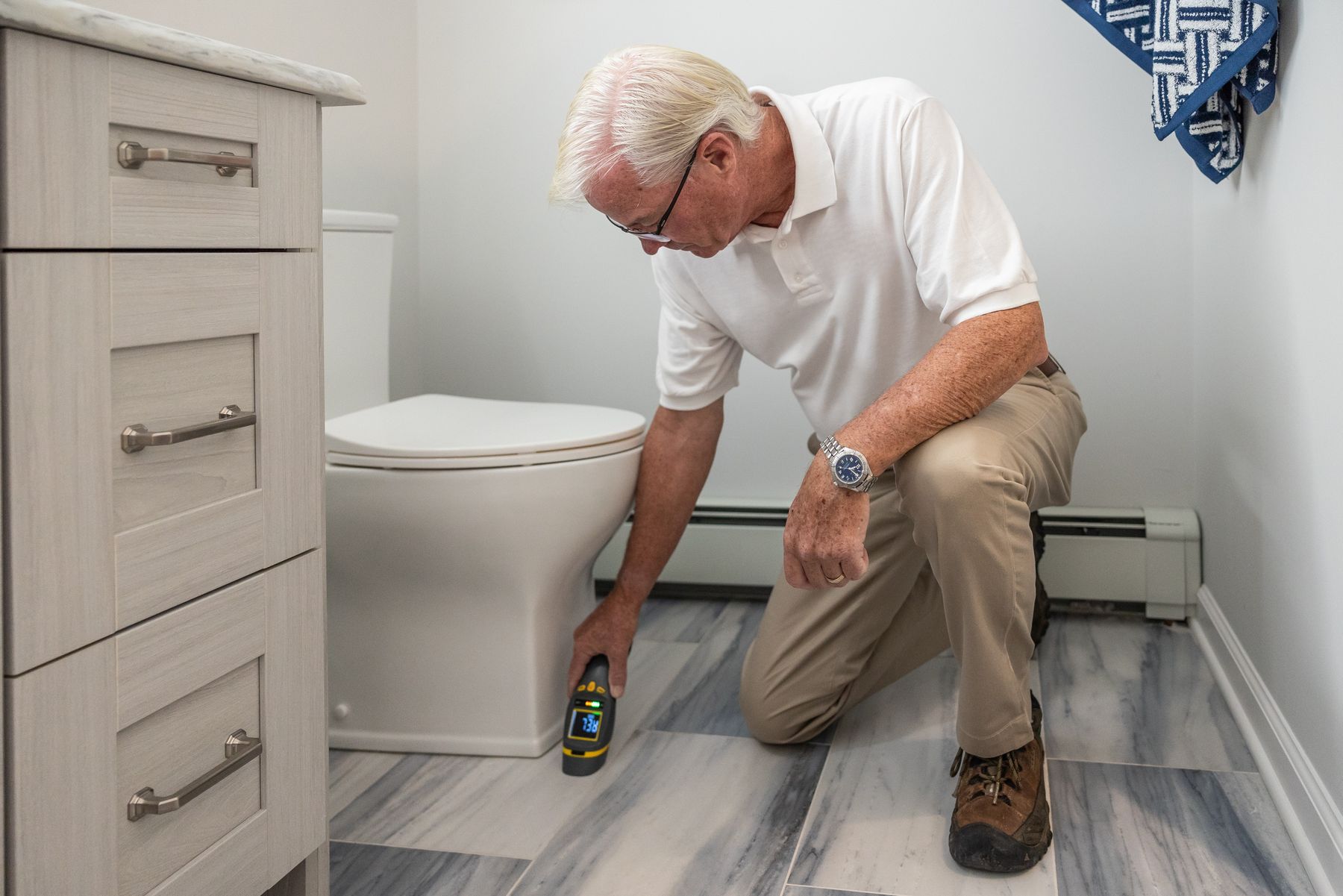
- What tools inspectors use: Inspectors combine visual examination with non-destructive tools. These include pin and pinless moisture meters, hygrometers for temperature and relative humidity, and infrared thermography to identify temperature patterns that may suggest wet areas.
- What infrared can and cannot show: Infrared imaging doesn’t directly detect moisture. It helps locate suspicious temperature differences that should be confirmed with a moisture meter or further inspection.
- What the inspection should document: A proper moisture inspection should identify likely causes such as leaks, condensation, capillary wicking, high humidity, or drainage problems.
- Why drying goals matter: Standards in building science and water damage restoration emphasize measuring wet materials, setting drying goals, and verifying that materials return to normal moisture conditions.
- How this helps prevent repeat mold: Moisture correction reduces the chance that mold will return after cleaning or remediation. Without fixing the water source, mold growth can come back even after affected materials are removed.
Key Differences At a Glance
Distinguishing between these two approaches helps you choose the exact service your property needs right now.
| Topic | Mold Testing | Moisture Inspection |
| Main Purpose | Identify and characterize mold presence via samples | Find moisture sources, map wet materials, and define repairs |
| Best Use Cases | Suspected hidden growth, documentation, and clearance after remediation | Visible growth, musty odors, leaks, floods, and high humidity issues |
| Typical Tools | Air cassettes, swabs/tape, bulk, dust, DNA panels | Moisture meters, RH/temperature, infrared, visual,l and probe inspections |
| Answers You Get | What kinds of spores or colonies were captured at the sample points | Why is moisture present, which assemblies are wet, and how to correct them |
| Limits | No federal exposure limits; snapshot in time; results easy to misread | Does not name species; may require selective test cuts to confirm |
| Who Usually Does It | Indoor environmental professional with lab support | Water damage/restoration or building envelope specialist |
| Deliverable | Lab report plus interpretation in a written assessment | Written moisture map, cause analysis, repair plan, and drying targets |
When to Test, When to Inspect
Timing is everything when trying to shield your family from hidden airborne irritants.
- Start with a moisture inspection when you see mold or know there was water damage. Most public and industry guidance says you don’t need sampling to begin cleanup if growth is visible.
- After a flood or other significant water event, a mold inspection after a flood can help identify hidden moisture and areas where mold may be more likely to develop.
- Targeted testing provides the clear evidence you need when hidden growth eludes standard inspection tools or when highly sensitive occupants are involved. This approach also serves as documentation required by insurance providers, landlords, or specific project guidelines to verify that containment is entirely effective.
- Always separate roles on larger jobs. A qualified assessor writes the scope and performs post‑remediation verification. The remediation contractor executes that scope. Independent clearance testing, when needed, reduces conflicts of interest and confirms the space is clean and dry.
- For exterior leaks and complex assemblies, add specialized leak evaluation. Structured water tests and envelope diagnostics help you fix the root cause before interior work begins.
If you’re unsure which step comes first, our certified site surveillance technicians can begin with a visual assessment of visible growth, water damage, humidity concerns, and likely moisture sources. From there, the inspector can recommend targeted sampling only when it will add useful information.

Common Myths to Skip
Clearing up these misconceptions helps readers avoid unnecessary tests, incomplete repairs, and repeated moisture problems.
- A single air test will tell me if my house is safe. In reality, there’s no federal pass/fail number for mold spores, and results vary with weather, activity, and sampling methods.
- ERMI is an all‑purpose home test. ERMI is an EPA research tool. It’s not an EPA‑approved screening for real estate or medical decisions.
- If I paint over the mold, the problem is gone. Paints and coatings don’t remove contamination or fix the source of moisture.
- Moisture meters and infrared are gimmicks. They’re core tools in standards‑based inspections and, used properly, show where to open and repair with minimal demolition.
Examples
Real scenarios paint a clear picture of how these assessments solve persistent, frustrating property puzzles.
Bathroom Spots That Keep Coming Back
A homeowner sees gray spots on the bathroom ceiling every winter. A moisture inspection finds the exhaust fan duct disconnected in the attic, dumping warm, humid air onto cold roof sheathing. Surface cleaning alone never lasted because condensation kept feeding growth.
The fix was simple: reconnect and insulate the duct, verify airflow, clean and dry the ceiling, and repaint after moisture readings stabilized. No lab testing was needed.
Musty Finished Basement With No Visible Mold
A family notices a persistent musty odor in a finished basement after heavy rains. The inspector maps elevated moisture along baseboards with a pin meter and confirms cold, damp zones with infrared imaging. A wall opening reveals wet, moldy paper‑faced drywall behind built‑ins near a downspout discharge.
The plan: redirect roof runoff, add footing drain maintenance, remove affected finishes under containment, dry the slab edge, and reinstall with non‑paper facings. Limited air and surface samples were taken pre‑ and post‑remediation to document hidden growth and clearance. Results matched the inspection findings and confirmed a clean, dry handoff.
Actionable Steps / Checklist
Immediate tasks give you immediate control over your indoor environment before a small leak becomes a massive headache.
- Triage fast: If materials get wet, start drying within 24-48 hours and stop the water source.
- Look and sniff: Note stains, swelling, rust, peeling paint, and musty odors. Track patterns after rain or showers.
- Measure it: Use a hygrometer to check RH and temperature. Aim to keep indoor RH generally below about 60%.
- Map moisture: If you own a pinless meter, scan suspect walls and floors. Confirm any unusual readings with a pin meter or, where possible, a professional inspection.
- Ventilate and dehumidify: Run bath and kitchen exhausts to the outdoors. Use a dehumidifier in damp spaces. When visible growth exists, prioritize moisture inspection and remediation over routine air testing.
- Hire by standard: Ask pros what standard they follow (like ANSI/IICRC S520 for mold, S500 for water damage) and how they document compliance.
- Separate roles on larger projects: An independent assessor for scope and clearance, a different firm for remediation.
- Verify fixes: Recheck moisture content and RH after repairs. Consider targeted post‑remediation verification as needed.
Glossary
Technical terms don’t have to be confusing when you’re trying to protect your home.
- Indoor Environmental Professional (IEP): A qualified specialist who assesses indoor air quality issues, designs sampling plans, and interprets results.
- Spore Trap Sample: An air sample that captures airborne particles on a cassette for microscopic identification and counting.
- ERMI: Environmental Relative Moldiness Index; an EPA research method that scores dust DNA for certain molds and isn’t a general home screening.
- Moisture Meter: A handheld tool used to estimate moisture in building materials. Pin meters use probes, while pinless meters scan noninvasively below the surface.
- Infrared Thermography: Imaging that shows surface temperature patterns to help locate likely wet or leaky areas.
- Psychrometrics: The science of air, moisture, and heat; used to set and verify drying conditions.
- Clearance Testing: Post‑remediation checks, sometimes with samples, to confirm cleaning and drying met the project criteria.
- Relative Humidity (RH): The percentage of water vapor in the air compared to the maximum it can hold at that temperature.
FAQ
Q: Do I need mold testing if I can see mold?
A: Usually not. If mold is visible, most guidance supports fixing the moisture source and remediating the growth without routine sampling.
Q: What does a moisture inspection include?
A: A systematic search for leaks and damp materials using visual methods, moisture meters, RH/temperature readings, infrared imaging, and, if needed, targeted openings or water tests.
Q: When is air testing useful?
A: Air testing is useful when growth is suspected but hidden, to evaluate containment during work, or to document pre‑ and post‑remediation conditions as part of a written scope.
Q: Are DIY petri dishes or single-room tests reliable?
A: DIY tests often mislead. Mold is everywhere. Growth on a plate doesn’t prove a building problem, nor does it point to the source.
Q: Who should I hire?
A: Look for an assessor and a remediator who reference recognized standards, provide written scopes and moisture maps, and document drying or clearance criteria.
Final Thoughts
If you fix moisture, you fix mold. Start with a focused moisture inspection to find causes and affected materials, then use mold testing only when it answers a specific question. Use testing with intent, not by default, and verify cleanup against a clear standard. That sequence protects the building, reduces wasted testing, and gives property owners clearer next steps.
The right first step can save time, reduce unnecessary testing, and make cleanup decisions feel less overwhelming. Rarefied Air Environmental can document visible conditions, collect targeted samples when they add value, and verify whether remediation met the agreed criteria.