
Direct fungal examination is a laboratory method that examines fungal spores, fragments, and other structures collected from air, surfaces, or building materials without first culturing the fungi.
For an indoor mold investigation, that distinction matters. Because the sample can be examined microscopically, rather than waiting for organisms to grow, direct fungal examination (DFE) can provide relatively rapid information about what was present in the sample when it was collected.
DFE isn’t intended to answer every question about mold. It generally cannot determine whether individual spores are alive, may not identify fungi to the species level, and shouldn’t be used by itself to determine health risk.
Instead, it’s one analytical tool that can support a broader investigation involving the building’s moisture history, visual conditions, sampling objective, and other findings.
TL;DR
- Direct fungal examination uses microscopy to evaluate fungal structures collected from air, surfaces, or building materials without culturing them first.
- DFE can detect both viable and nonviable fungal structures and typically provides results faster than culture-based analysis.
- It usually cannot determine viability or identify every fungus to the species level, and it doesn’t establish health risk on its own.
- Most laboratories do DFE as part of a broader mold investigation that may include visual evaluation and air, surface, or bulk sampling.
What Is Direct Fungal Examination?
Direct fungal examination means evaluating collected fungal material under a microscope without culturing it first. In environmental testing, samples may come from:
- Air collected using a spore-trap sampling device
- Suspect growth collected with a tape lift
- Surface material collected with a swab
- Small portions of affected building materials submitted as bulk samples
Under the microscope, an analyst evaluates structures based on characteristics such as size, shape, pigmentation, septation, and other visible morphology. Depending on the sample and fungal structures present, the laboratory may be able to identify certain spores or structures to a genus or broader group.
Some fungi have spores that look too similar under direct microscopy to separate reliably. Aspergillus and Penicillium spores, for example, are commonly reported together unless identifying structures are present.
Why Direct Examination Is Different From Fungal Culture
Direct fungal examination and fungal culture can both contribute to a mold investigation, though they answer different questions. The main distinction is that DFE examines fungal material collected in the sample without requiring the organisms to grow first. Key differences include:
- DFE can detect viable and nonviable spores because it examines the collected material directly under a microscope.
- Culture focuses on viable fungi that can grow under the selected laboratory conditions.
- Culture results can depend on several variables, including growth medium, incubation conditions, sampling stress, and how readily a fungus grows.
- DFE provides a broader microscopic view of the fungal structures physically captured during sampling.
- Culture may provide different information when viability or growth characteristics are important to the investigation.
Neither method answers every environmental question. The best option depends on what the investigation needs to determine and whether direct examination, culture, or a combination of methods provides the most useful information.
When Direct Fungal Examination May Be Useful
DFE can be particularly helpful when microscopic findings may provide more information about a suspected mold condition inside a property. Rather than testing without a clear purpose, direct examination is most useful when the results can address a specific concern or support the next step in an investigation.
DFE may be considered when you need to:
- Evaluate suspected surface growth to determine whether the material contains recognizable fungal structures.
- Distinguish possible mold from other materials such as dirt, soot, staining, or surface residue.
- Examine air samples for the types and concentrations of fungal spores captured during the sampling period.
- Investigate possible hidden mold when odors, moisture, or building conditions suggest a concealed source.
- Assess water-damaged materials when fungal growth is suspected on or within affected building components.
- Support remediation decisions with laboratory findings that can be considered alongside the property inspection.
Testing may not be necessary simply to confirm mold that is already clearly visible, since visible growth can indicate an existing moisture and cleanup concern. When sampling could provide useful additional information, a professional inspector can determine which method and sample locations best match the purpose of the investigation.
Direct Fungal Examination Methodology
A professional DFE investigation begins before a sample ever reaches the microscope. The steps below show how environmental testing specialists can plan sampling, collect appropriate samples, analyze them, and interpret the findings so property owners don’t have to make technical testing decisions themselves.
1. Define the Sampling Objective
During a professional assessment, the first step is defining what the sampling needs to answer based on the property concern and inspection findings. An investigation might be designed to answer questions such as:
- Is a suspicious surface actually supporting fungal growth?
- Are fungal spores present in indoor air at a pattern or concentration that warrants further investigation?
- Is there evidence suggesting a hidden indoor fungal source?
- What fungal structures are present on a water-damaged building material?
- Do post-remediation findings support the conclusion that cleanup has been successful?
Testing specialists can then select a sampling method that addresses that question rather than collecting samples simply because testing is available.
2. Evaluate the Building and Moisture Conditions
For property owners, laboratory results are most useful when they’re connected to what is happening at the property. An assessment may consider visible growth, water staining, previous leaks, flooding, condensation, building materials, musty odors, moisture conditions, and other evidence of water intrusion before interpreting the laboratory findings.
An air sample represents conditions during a limited sampling period. It doesn’t identify every hidden source of mold in a building on its own. Air sampling is most useful when it supports conclusions drawn from the broader investigation rather than serving as a standalone pass-or-fail test.
3. Select the Appropriate Sample Type
Testing specialists select the sample type according to the question being investigated, so property owners don’t need to choose between air, tape-lift, swab, or bulk sampling.
- Air Samples: Capture airborne particles from a measured air volume for microscopic identification and concentration estimates, commonly reported as spores/m³.
- Tape-Lift Samples: Use clear adhesive to collect suspect surface material and determine whether recognizable fungal structures are present.
- Swab Samples: Collect material from targeted surfaces when tape lifts are difficult, or another surface-sampling method is more appropriate.
- Bulk Samples: Submit pieces of affected building materials for direct examination when the material itself needs evaluation.
4. Examine the Sample Microscopically
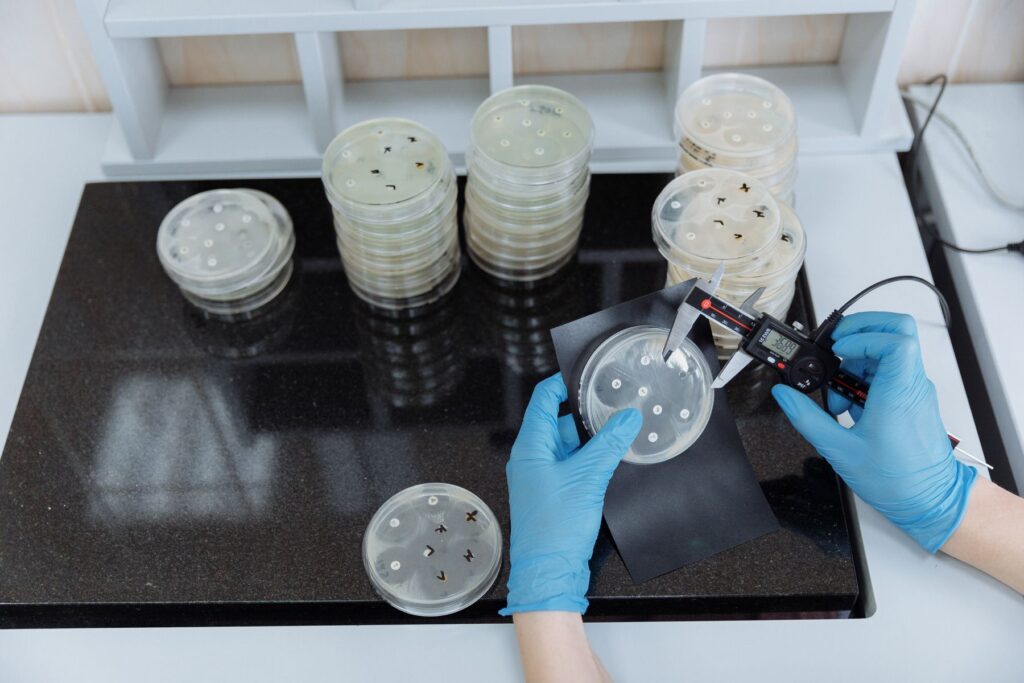
In the laboratory, the collected material is prepared so that fungal structures can be viewed under magnification. The analyst evaluates identifiable fungal spores, hyphae, fragments, and other relevant particles based on their microscopic morphology.
Some structures can be classified relatively specifically. Others are reported as broader groups when microscopic appearance doesn’t support a more precise identification. This is an important limitation of direct fungal examination. Don’t present microscopic identification as more specific than the visible structures allow.
5. Record and Report the Findings
The form of the result depends on the sample type. Air samples may provide concentrations of recognized spore types or groups. Surface and bulk samples may be reported according to the fungal structures observed and their relative abundance or other laboratory reporting conventions.
The report should make clear what was observed rather than implying that a microscopic result establishes facts the method cannot determine. For example, direct examination can detect both viable and nonviable fungal spores, so finding a spore microscopically doesn’t establish whether that individual spore was capable of growing.
6. Interpret the Laboratory Results With the Site Findings
After laboratory analysis, our testing specialists can review the findings alongside conditions documented at the property rather than presenting clients with standalone numbers that lack context. Interpretation may consider:
- Indoor and outdoor sample patterns when comparison samples are appropriate
- Types of fungal structures observed
- Relative or measured concentrations
- Locations of samples
- Visible fungal growth
- Moisture measurements
- Water-damage history
- Building conditions
- Remediation history
No federal standards establish a universally acceptable concentration of airborne mold spores. Results therefore shouldn’t be treated as a simple numerical “safe” or “unsafe” threshold.
For the property owner, this combined interpretation provides a more useful picture of what the laboratory findings may mean and whether another step is warranted.
What Direct Fungal Examination Can Tell You
When properly collected and interpreted, direct fungal examination can help determine whether fungal structures are present in a sample and provide information about their general morphology or fungal group.
Because fungi don’t need to grow to be observed, direct examination can detect spores that are no longer viable. This also applies to spores that may not grow readily under the culture conditions selected for another test.
This makes DFE particularly useful when the goal is to characterize the fungal material physically captured during sampling rather than only the portion that can subsequently be cultured.
This is one of the method’s most important advantages. It avoids some of the limitations introduced when fungal detection depends on whether organisms survive sampling and successfully grow on a specific medium.
What Direct Fungal Examination Cannot Tell You
DFE also has important limitations.
- It usually doesn’t identify the exact species: DFE often identifies fungi only to a genus or broader morphological group.
- It doesn’t determine viability: DFE detects both viable and nonviable fungal structures, so culture may be needed.
- It doesn’t establish health risk: DFE results don’t diagnose illness or define a safe airborne mold concentration.
- An air sample is a snapshot: Results reflect conditions during collection and can change as airflow and activity change.
- A surface sample doesn’t describe the entire building: Results apply only to the sampled location, not the entire property.
Direct Fungal Examination vs. Culture
Comparing direct fungal examination with fungal culture shows why each method answers a different question.
| Question | Direct Fungal Examination | Fungal Culture |
| Does the fungus have to grow before analysis? | No | Yes |
| Can nonviable spores be detected? | Yes | No, not as colony growth |
| Can the method determine viability? | No | Shows organisms capable of growing under the selected culture conditions |
| Typical analytical speed | Relatively rapid | Requires incubation and therefore takes longer |
| Identification | Often genus or morphological group | May allow more specific identification when organisms grow successfully |
| Main analytical limitation | Cannot reliably establish viability or species for many fungi | Results depend on viability and the organisms’ ability to grow under selected conditions |
| Useful when | A rapid microscopic profile of collected fungal material is needed | Viability or culture-based identification is important |
Direct fungal examination is therefore not inherently “better” than culture in every investigation. They answer different questions. The appropriate method depends on the sampling objective.
Why Bypassing Culture Can Speed Up Environmental Mold Testing
One practical advantage worth preserving from the original discussion of DFE is speed. Culture requires time for organisms to grow before you can evaluate colonies. Direct fungal examination bypasses that cultivation stage by viewing the collected structures microscopically.
That can shorten the analytical portion of the process and help property owners, managers, restoration professionals, and other stakeholders make decisions sooner. Faster analysis can be especially valuable when the investigation affects remediation planning, occupancy decisions, construction schedules, or post-remediation verification.
We operate our own certified and accredited laboratory. With our in-house laboratory, we can deliver faster results and expand the understanding of environmental hazards at the microscopic level.
Quality Considerations for DFE Sampling
The quality of direct fungal examination depends heavily on decisions made during professional sampling and laboratory analysis. When developing the sampling approach, we can account for the investigation’s objective, representative sample locations, building conditions, appropriate equipment, and proper sample handling.
For air testing, conditions such as HVAC operation, room activity, outdoor conditions, sample location, and air volume can influence what is captured. Property owners can help by sharing relevant water-damage or remediation history while the inspection team handles the technical sampling decisions.
The EPA recommends having mold samples analyzed using methods recognized by organizations such as the American Industrial Hygiene Association and other professional bodies.
When Is Direct Fungal Examination the Right Choice?
DFE is most useful when microscopic analysis can help answer a specific question about conditions inside a property. Rather than testing simply because mold is suspected, use DFE when the results could provide meaningful information for the investigation or next steps. It may be appropriate when you need to:
- Examine suspect surface growth to determine whether fungal structures are present.
- Evaluate air samples for the types and concentrations of fungal structures captured during sampling.
- Assess water-damaged building materials when mold growth is suspected within or on the material.
- Investigate possible hidden mold when odors, moisture, or other conditions suggest a concealed source.
- Support post-remediation evaluation with laboratory findings that can be reviewed alongside inspection and moisture conditions.
DFE may not be necessary to confirm obvious visible mold, since visible growth can already indicate a moisture and cleanup problem that needs attention. A professional inspector can help determine whether direct fungal examination, another testing method, or no additional sampling is the most appropriate choice for the property.
How Rarefied Air Uses Direct Fungal Examination
Rarefied Air Environmental incorporates direct fungal examination into a broader professional mold-testing process rather than treating microscopy as a standalone answer. Depending on the property and investigation, the assessment may include visual evaluation, air sampling, surface swabs or tape lifts, bulk material sampling, laboratory analysis, and recommendations based on the findings.
Bringing field assessment and laboratory analysis together allows findings to move from sample collection to interpretation and reporting without treating the laboratory number in isolation. The goal isn’t to collect as many samples as possible. It’s to choose testing that answers the property’s actual environmental question.
Has a musty odor, water event, visible suspected growth, hidden moisture problem, or previous remediation left you unsure about what is happening inside your property? Professional mold testing can determine whether direct fungal examination or another sampling method is appropriate.
Examples
Seeing how the method fits into a larger mold investigation makes it easier to picture how professional testing can provide useful answers when conditions inside a home or business feel uncertain.
Suspect Growth After a Plumbing Leak
A homeowner notices dark spotting on drywall a few weeks after a plumbing leak was repaired. A professional inspector may collect a tape-lift sample from the affected area for direct fungal examination to determine whether fungal structures are present.
The lab findings can then be reviewed alongside moisture readings, visible conditions, and the leak history. This gives the homeowner more useful information before deciding whether additional removal or remediation work is needed.
Musty Odor With No Visible Mold
A San Diego homeowner notices a persistent musty odor in a bedroom, even though there is no obvious mold growth on the walls or ceiling. A professional inspector may collect indoor air samples from the room for direct fungal examination to identify the fungal structures captured during sampling.
The inspector compares the results with inspection findings and, when appropriate, an outdoor reference sample. If the indoor pattern raises concern, the inspector can focus further investigation on possible hidden moisture behind walls, flooring, or other materials.
Actionable Steps / Checklist
If you’re concerned about possible mold, a few simple steps can help make a professional investigation more focused and useful. The information you gather gives Rarefied Air Environmental better context for deciding whether direct fungal examination or another testing method is appropriate.
- Note visible concerns: Record staining, suspected growth, discoloration, or other changes you have noticed around the property.
- Document moisture problems: Write down known leaks, flooding, condensation, plumbing issues, or other sources of excess moisture.
- Track unusual odors: Note where musty odors occur, when they appear, and whether they seem stronger under certain conditions.
- Gather the property history: Include previous water damage, mold testing, remediation, renovations, or recurring moisture problems.
- Photograph affected areas: Clear photos can help document changes and give the inspection team additional context before testing.
- Avoid disturbing suspected growth: Scrubbing, cutting, or moving affected materials can alter conditions before a professional assessment.
- Keep normal conditions when possible: Avoid making major ventilation or cleaning changes immediately before an inspection unless instructed otherwise.
- Explain your main concern: Share whether you’re worried about visible growth, hidden mold, air quality, or previous remediation.
- Ask what the testing will answer: A useful sampling plan should address a specific question about conditions within the property.
- Review findings in context: Consider laboratory results alongside moisture conditions, inspection findings, property history, and sample locations.
Glossary
A short glossary can make technical terms tied to direct fungal examination easier to follow without interrupting the methodology every time a laboratory term appears.
- Direct fungal examination (DFE): Microscopic analysis of fungal material collected from environmental samples without first growing the organisms in culture.
- Spore trap: An air-sampling device that captures airborne particles for microscopic examination.
- Tape lift: A surface-sampling method using clear adhesive material to collect suspected fungal growth.
- Swab sample: Material collected from a surface with a sterile swab for laboratory analysis.
- Bulk sample: A physical piece of building material submitted to the laboratory for examination.
- Fungal structures: Microscopic fungal material, including spores, hyphae, and fragments.
- Hyphae: Thread-like fungal structures that make up part of the body of many molds.
- Fungal spores: Microscopic reproductive structures produced by fungi that may become airborne or settle on surfaces.
- Viable spores: Spores capable of growing under suitable conditions.
- Nonviable spores: Spores unable to grow yet still visible through direct microscopic examination.
- Fungal culture: A laboratory method that grows collected organisms on media to evaluate viable fungi.
- Spores/m³: Spores per cubic meter, a common unit for reporting airborne fungal concentrations.
FAQ
Is direct fungal examination the most accurate mold test?
No single mold-testing method is best for every investigation. Direct examination is valuable because it can rapidly visualize fungal structures without requiring them to grow. Culture, molecular methods, and other analytical techniques answer different questions. The appropriate method depends on what you need to learn.
Can direct fungal examination identify the exact mold species?
Not always. Some fungal structures can be identified relatively specifically, while morphologically similar fungi may need to be reported as a group. Direct microscopy alone often cannot provide species-level identification.
Does DFE detect dead mold spores?
Yes. Direct microscopy can detect both viable and nonviable fungal structures. Because of that, a positive microscopic finding doesn’t automatically mean the spores observed are alive.
Can DFE tell whether mold is dangerous?
No. Direct fungal examination identifies and characterizes fungal material in the collected sample. It’s not a medical test and doesn’t establish whether a particular indoor concentration will cause health effects.
Is an air sample enough to determine whether a building has mold?
Not by itself. An air sample represents conditions during the sampling period. A proper mold investigation also considers moisture, visible conditions, building history, sample locations, and other relevant evidence.
When would culture be more useful?
Culture may be appropriate when you need to determine whether fungal organisms are viable or when the investigation requires more specific identification from successfully grown organisms.
How fast are DFE results?
DFE is usually faster than fungal culture because the sample can be examined under a microscope without waiting for mold to grow. In many professional mold investigations, laboratory results are available within about 48 hours.
Final Thoughts
The value of direct fungal examination is not that it’s universally superior to every other fungal test. Its value comes from what it does particularly well: providing a rapid microscopic view of fungal structures in a collected environmental sample without first requiring those organisms to grow.
DFE can avoid some of the losses and biases associated with relying solely on culture while still providing useful information about the fungal material present in air, on a surface, or within a sampled building material. Used as part of a well-designed environmental investigation, DFE can help turn a collected sample into useful evidence about what is happening inside a property.
Rarefied Air Environmental combines field assessment, direct fungal examination, and in-house laboratory analysis to help property owners and professionals determine what the evidence means and what step, if any, should come next.