
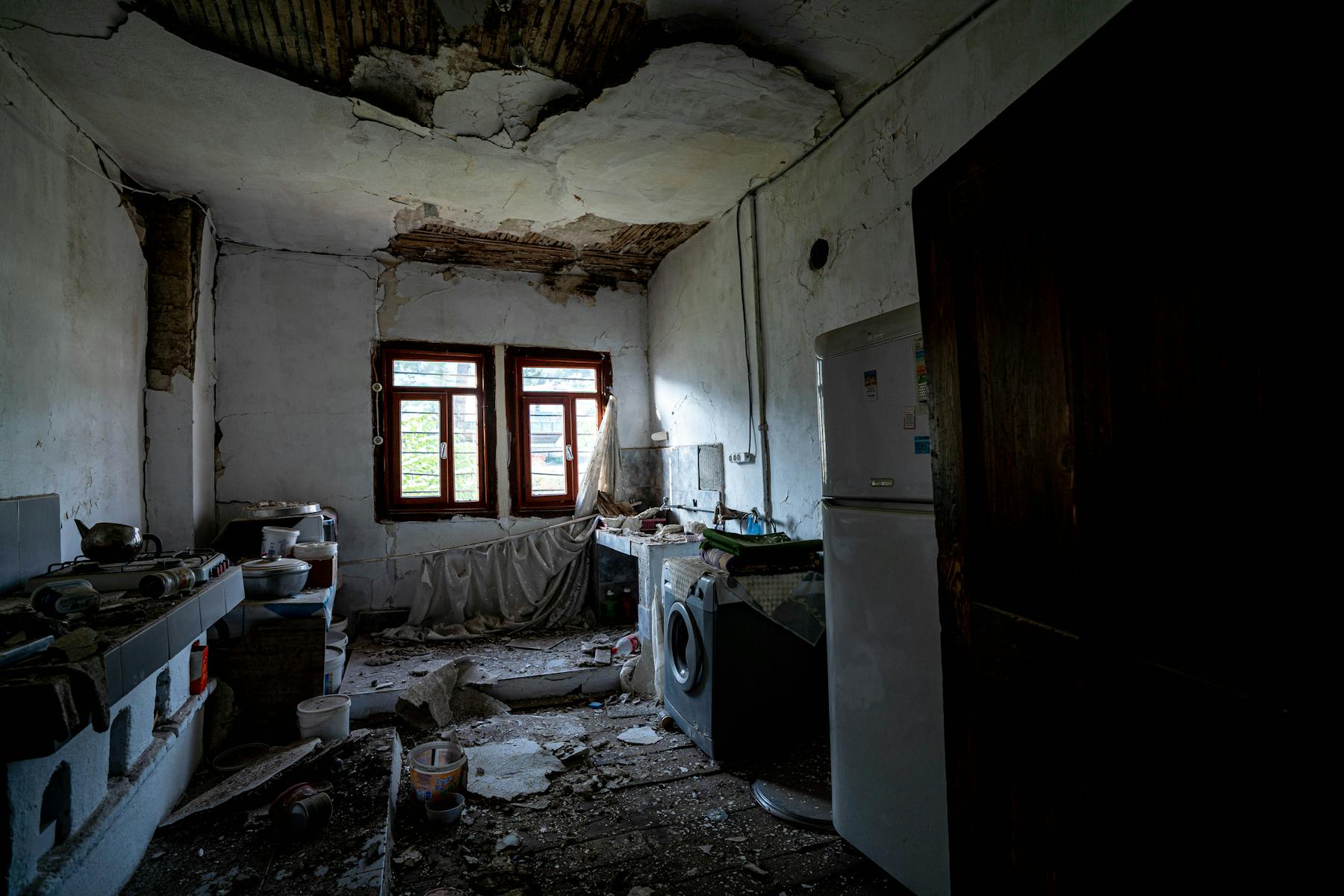
When contractors say “poria”, they’re usually referring to the destructive wood-decay fungus Meruliporia incrassata (historically called Poria incrassata). It is a brown‑rot fungus that eats the strength out of framing and subfloors.
The catch: poria often hides behind finishes and can move moisture through rope‑like strands, so the damage may appear far from the leak. That is why identification needs more than a quick look and a moisture meter.
TL;DR
- Poria is a wood‑decay fungus that requires moisture but can transport it to attack seemingly dry wood.
- Visual inspections miss early or hidden growth and often confuse poria with look‑alike stains, salts, or other fungi.
- Reliable identification pairs moisture mapping with targeted sampling (often bulk material/wood) and lab confirmation (commonly microscopy/DFE and certified lab reporting). DNA testing may be used by specialty labs when needed.
- Standards recognize that even thorough surveys can overlook concealed growth, so verification and source‑of‑water fixes are essential.
What Poria Fungus Is
Meruliporia incrassata, long known in building literature as Poria incrassata, causes brown rot, leaving wood dry, brittle, and cubically cracked. In buildings, it may form white to yellow mycelial fans and thick cords called rhizomorphs that can conduct water across building materials. That ability lets the fungus establish away from a leak or damp soil, which complicates on‑site diagnosis and containment.
Moisture drives the problem. As a field rule of thumb, decay fungi generally need ~20% wood moisture content or higher to persist, and risk rises sharply with prolonged wetting near the fiber saturation point (often around ~30% MC, depending on species). These thresholds come from long‑standing Forest Service research and underpin modern moisture assessments.
If you’re seeing repeated dampness, staining, or soft wood but can’t pinpoint why, professional moisture mapping plus targeted bulk sampling can reduce guesswork and keep repairs focused.
Why Visual Inspections Fail
Visual inspection is a useful start, but it often underestimates hidden decay in framing and subfloors, especially when growth is behind finishes or when moisture is traveling through concealed pathways. A better approach combines moisture checks, strategic openings, and lab analysis so the repair scope matches what’s actually happening inside the assembly.
Because fruiting (and spore release) can be absent, air samples alone may not capture a definitive signature. Bulk sampling of affected material is often the most useful way to document what’s present.
Hidden Habitat and Long‑Range Spread
Poria thrives in dark, protected spaces: subfloors, wall cavities, rim joists, and behind finishes. Its rhizomorphs can tap soil or wet masonry and feed distant colonies, so the first visible damage may be far from the true source. A surface walk‑through often misses that network.
Looks Like Other Problems
Mycelial sheets can resemble efflorescence, mineral salts, or even construction dust. Brown‑rot damage can be mistaken for insect damage or normal aging. Without sampling, many inspectors misclassify the organism and prescribe the wrong fix.
Fruiting Bodies Are Rare Indoors
The easiest field ID is a mature fruiting body (basidioma). In buildings, fruiting is sporadic or absent, so there is no dependable mushroom‑like structure to ID. Classic USDA guidance notes that fruiting bodies may not form in structures at all.
Even Good Surveys Can Miss Concealed Growth
Assessment standards acknowledge limits. A systematic building survey can still overlook fungal growth hidden within assemblies. That is why confirmation testing at the right locations matters.
How Professionals Confirm It
A solid workup follows a moisture-first, evidence-driven path and uses sampling plus lab analysis (often DFE/microscopy and certified reporting) to clarify what’s present and what to do next.
- Moisture mapping: Pin and pinless meters plus strategic test cuts/openings where indicated. Where decisions hinge on precise values, oven-dry measurement can be used to confirm wood moisture content.
- Targeted sampling: Collect small wood chips or mycelial material from the active margin of damage, not the driest, powdery core. Avoid biocides before sampling and use clean tools and paper bags.
- Microscopy and culture: Lab mycologists can often classify decay type and narrow candidates. Culture‑based ID may be inconclusive without a fruiting body.
- DNA confirmation (optional): Some specialty labs can use DNA methods (including ITS-based approaches) when species-level confirmation is necessary. However, many real-world building investigations rely primarily on DFE/microscopy plus certified lab reporting and targeted material sampling.
If you want results that are easy to act on, Rarefied Air Environmental can perform air sampling (indoor air quality), surface testing (tape/swab), and bulk sampling (materials). We can also provide DFE and certified lab analysis with actionable recommendations.
Choosing Your Diagnostic Path: Science-Backed Methods Compared
This section empowers you to recognize when a quick look isn’t enough and when it’s time to call in the advanced tools that ensure no hidden threat is left behind.
| Factors | Visual inspection & moisture mapping | Microscopy/culture (lab) | DNA barcoding/qPCR (lab) |
| What It Tells You | Where materials are wet and damaged | Decay type and likely groups | Species‑level confirmation via ITS |
| Strengths | Fast; guides openings and sampling | Low cost; supports causation | Highest specificity; works on small samples |
| Limits | Can miss concealed growth; look-alikes are common without lab confirmation | Species‑level ID is often uncertain without fruiting | Needs proper sampling; not every lab tests every species |
| Best Use | First pass; choose cut locations | When DNA is unavailable or to corroborate the DNA | When species-level confirmation is needed, and an appropriate lab method is available |
If you’re in San Diego County and need a documented baseline before repairs, our professional sampling with lab reporting can help you avoid under- or over-demolition.
What An Effective Inspection Looks Like
Professional inspections go beyond the surface by tracking how water is moving and using targeted sampling with DFE/microscopy and certified lab reporting to clarify what’s present. This comprehensive approach provides the technical roadmap needed to set accurate repair limits and implement permanent moisture fixes, ensuring your sanctuary remains safe for years to come.
- Start with the physics by tracking water. Survey exterior drainage, plumbing, grade, and crawlspace conditions.
- Map elevated moisture in wood and finishes. Open discreet test cuts at the wettest spots and along likely rhizomorph paths, such as foundation lines, sill plates, and under wet rooms.
- Collect representative samples before any chemical treatments. Send them to a lab experienced with building fungi for microscopy and ITS sequencing or a validated species‑specific PCR.
- Use results to set removal limits, often extending past visibly damaged wood to capture hidden strands and ensure clean margins.
- Pair structural repair with durable moisture fixes, not just antimicrobial sprays.
If you want a clear plan you can hand to a contractor or remediation firm, request an inspection that includes sampling, lab results, and written recommendations.
Examples
These illustrative scenarios show how an investigation can unfold. Actual findings and outcomes vary by building conditions and moisture history.
A Crawlspace Success Story
A crawlspace home in a humid region showed spongy floors near the dining room, but the crawlspace looked mostly dry. Moisture readings in joists were 24% to 28% near the rim. A small access cut revealed white mycelial fans trailing onto the foundation wall and a dark cord running toward a planter against the exterior.
DNA testing of a wood chip confirmed Meruliporia incrassata. The fix removed affected framing beyond the visible edge, installed drains and soil covers, and improved grading. Follow-up moisture checks and verification can help confirm conditions remain dry and stable over time.
Solving a Persistent Decay Mystery
In a mid‑century slab‑on‑grade house, cupped hardwood floors appeared 12 feet from a powder room leak that had been repaired months earlier. Thermal imaging showed a cool strip at the baseboard. Behind it, a papery growth coated the sheathing.
Lab microscopy showed brown‑rot features, and ITS sequencing confirmed Meruliporia. The team removed base cabinets and baseboards along the entire wet wall, replaced sheathing and sill where weakened, and sealed plumbing penetrations. Follow‑up moisture checks stayed under 15%, and the new flooring remained stable.
Actionable Steps / Checklist
Whether you’re a homeowner, property manager, or buyer preparing for repairs, the goal is the same: document moisture, confirm what’s present, and fix the source so the problem doesn’t repeat. Following this professional protocol ensures that every moisture source is silenced and every structural repair is built to last, giving you confidence in your home’s future.
- Trace and correct water sources first, including exterior grading, gutters, irrigation, leaks, and crawlspace humidity.
- Map wood moisture. Flag readings near or above 20% and prioritize openings where you see 25% to 30% or persistent wetness.
- Make small test cuts to follow suspect strands along foundations, sills, and hidden cavities.
- Collect clean samples from the active growth edge. Bag in paper, label, and ship promptly.
- Ask the lab for ITS sequencing and, if available, species‑specific PCR for dry‑rot fungi.
- Set removal limits to include visibly damaged wood plus a safety margin that captures hidden mycelium and rhizomorphs.
- Replace structural members that have lost strength. Don’t rely on coatings alone.
- Ventilate and condition crawlspaces as needed. Install soil vapor barriers and maintain drainage.
- Verify dry‑down after repairs. Aim for stable readings well under 20% before closing assemblies.
- Document conditions with photos, meter logs, and lab reports to support warranties and resale.
Glossary
Understanding these terms turns a confusing technical report into a clear narrative, ensuring you feel in control of the restoration of your sanctuary.
- Brown rot: Wood decay that removes cellulose and hemicellulose, leaving brown, brittle, crackled wood.
- Rhizomorph: A cordlike bundle of fungal hyphae that can transport or conserve water and extend growth.
- Mycelial fan: A thin, papery sheet of fungal hyphae spreading over surfaces in protected spaces.
- Basidioma: The fruiting body of a basidiomycete fungus; often absent indoors.
- ITS barcoding: DNA identification using the internal transcribed spacer region, the primary barcode for fungi.
- Fiber saturation point: The wood moisture range, roughly 25% to 30%, where cell walls are saturated, and decay can initiate.
- Moisture mapping: Systematic use of meters and test cuts to locate wet materials and hidden leaks.
- qPCR: Quantitative polymerase chain reaction, a DNA test that can target specific species.
FAQ
Final Thoughts
Poria problems are moisture problems first. Use your eyes to find patterns, your meters to find the wet zones, and a competent lab to name the organism. Confirmed ID plus durable water control keeps repairs smaller, safer, and far less likely to be repeated.
If you’re trying to figure out whether what you’re seeing is a wood-decay fungus versus surface mold or mineral deposits, Rarefied Air Environmental can collect air, surface, and bulk samples and use Direct Fungal Examination (DFE) with certified lab analysis to provide clear findings and next-step recommendations.